Edge Delta AI Event Destination
4 minute read
Overview
The Edge Delta AI Event destination node sends connector events and telemetry data to AI teammates for AI-powered event processing and automated incident response. This destination enables AI teammates to monitor event streams from connected systems and initiate autonomous investigations when conditions warrant attention.
Note: The AI Event destination receives data only from event connectors. Streaming connectors send data to Edge Delta pipelines, and AI teammates access that data through the Edge Delta MCP connector. No special data formatting is required—teammates query observability data directly from the Edge Delta backend.
- incoming_data_types: log, metric, cluster_pattern_and_sample, custom, trace, archive, datadog_payload, diagnostic, health, heartbeat, signal, source, source_samples, splunk_payload
When you configure your first event connector for AI Team (such as AWS EventBridge, PagerDuty, or GitHub webhooks), Edge Delta automatically creates a dedicated ingestion pipeline called OnCall_AI_Connectors that routes data to this destination. All event connectors are added as inputs to this AI Team ingestion pipeline, with all data routing to the AI Event destination.
Note: Accounts created before the ingestion pipeline release may use cloud pipelines for AI Team connectors. These continue to function normally.
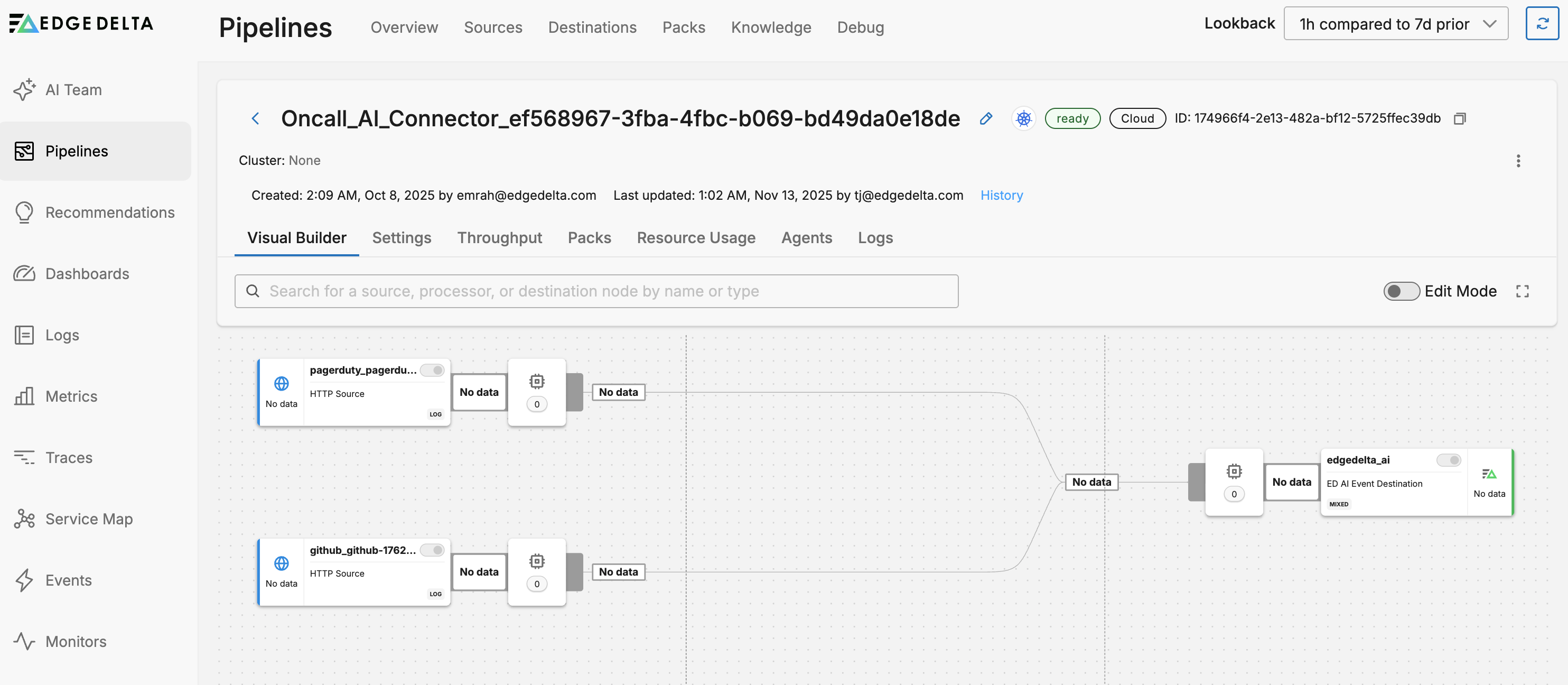
This node requires Edge Delta agent version v2.5.0 or higher and is available for Enterprise tier accounts.
Key Features
Support for Non-Log Data Types: Unlike traditional observability destinations, the AI Event destination accepts a wide range of data types beyond logs, including metrics, traces, custom telemetry, and connector-specific payloads. This enables AI teammates to analyze diverse telemetry streams and correlate events across systems.
Enhanced Connector Metadata: The destination preserves and enriches connector metadata, ensuring AI teammates have full context about event sources, connector types, and originating systems when performing investigations.
Autonomous Event Processing: AI teammates monitor the event stream continuously and initiate investigations autonomously when conditions warrant attention, without requiring explicit human prompts.
Example Configuration
The AI Event destination is created and configured automatically when you set up event connectors through the AI Team interface. This destination cannot be added manually to pipelines.
nodes:
- name: ai_teammates
  type: ed_ai_event_output
How It Works
When event data arrives at the AI Event destination:
- Event Reception: The destination receives events from configured connectors (PagerDuty incidents, GitHub pull requests, AWS CloudTrail notifications, security alerts, etc.)
- Metadata Enrichment: Connector metadata is preserved and enhanced with context about the source system
- AI Team Routing: Events are routed to relevant AI teammates based on their specializations and connector access
- Autonomous Processing: OnCall AI and specialized teammates analyze events, initiate investigations, and report findings in channels
- Context Preservation: Event context is maintained across interactions, building understanding over hours or days
Thread Creation and Routing
When events reach AI teammates through this destination:
- Thread Creation: OnCall AI creates a thread for each event that passes pipeline filters
- Channel Assignment: The system determines the appropriate channel using AI classification and predefined rules based on connector metadata and event content
- Silencing Evaluation: Some events may be marked as silenced based on configured rules—threads are still created, but OnCall AI won’t respond to them
- Event Normalization: Events are normalized to a consistent format before analysis
Events can be filtered at two levels before reaching AI teammates:
- Pipeline filters: Configure filters in the ingestion pipeline to block specific events before they reach AI teammates
- License limits: Events are blocked if account credits are exhausted or the account is suspended
Configuration
The AI Event destination is automatically configured when you:
- Navigate to AI Team in the Edge Delta app
- Configure an event connector (PagerDuty, GitHub, AWS EventBridge, etc.)
- Edge Delta creates the ingestion pipeline with the AI Event destination
This destination is managed entirely through the AI Team interface and cannot be added manually to pipelines through the Visual Pipeline Builder.
Differences from Other Edge Delta Destinations
The AI Event destination differs from other Edge Delta destinations in several ways:
- Automatic Creation: Created automatically when configuring event connectors; cannot be manually added to any pipeline type
- Broad Data Type Support: Accepts all telemetry types, including connector-specific payloads
- AI-Specific Routing: Routes data to AI teammates rather than observability platforms
- Metadata Preservation: Maintains rich connector and event metadata for AI analysis
- Context-Aware Processing: Events are processed with awareness of ongoing investigations and teammate specializations
memory_buffer
This parameter requires Edge Delta agent version v2.12.0 or higher.
The memory_buffer parameter configures the in-memory buffer queue for the destination. The size sub-parameter sets the maximum number of events to hold in the memory buffer queue before blocking. It is specified as an integer, has a default of 1000, and it is optional.
nodes:
  - name: <destination-name>
    type: <destination-type>
    memory_buffer:
      size: 2000