Legacy Integrations
2 minute read
Legacy Integrations are organization-level source and destination configurations managed separately from pipeline nodes. They serve as reusable connection settings for features that operate outside of individual pipelines:
- Rehydrations: Define archive sources and output destinations for replaying historical logs
- Monitors: Configure notification endpoints for backend alerts
- V2 Configurations (deprecated): Provide connection settings for legacy agent configurations
Legacy Integrations are different from Destinations, which are used to quickly populate pipeline destination nodes.
Configure a Legacy Integration
- Click Admin in the navigation bar.
- Click Legacy Integrations.
- Open the Available tab to see all integration types.
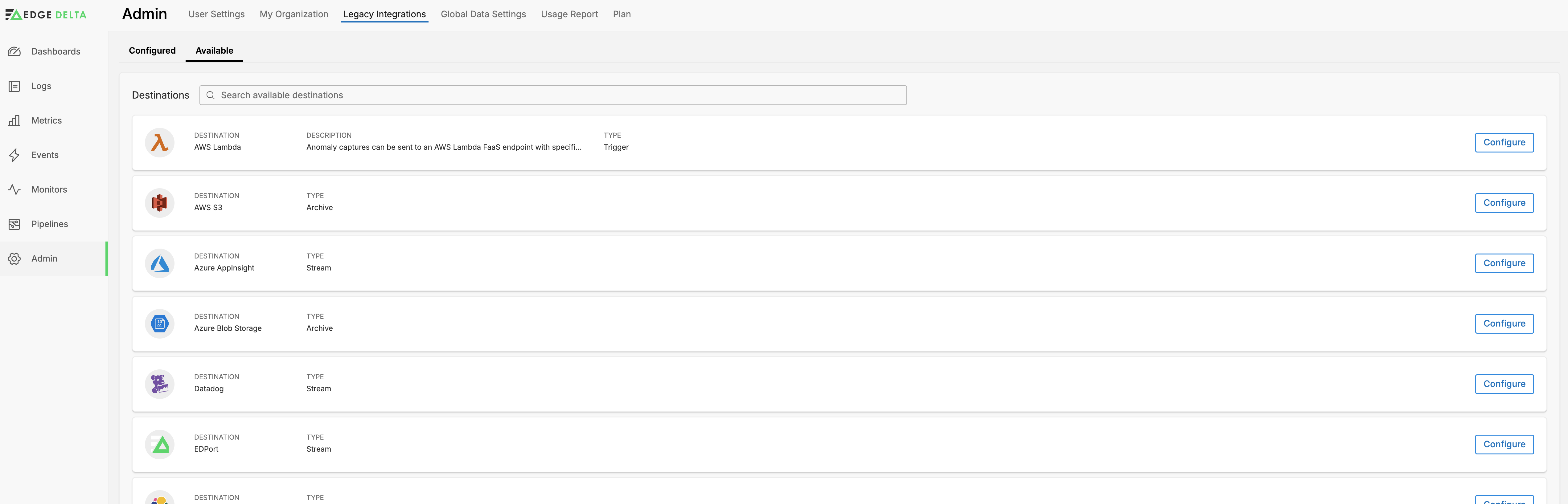
- Select the integration type you need:
- For rehydration sources: S3, GCS, or MinIO
- For rehydration destinations: Splunk, Elasticsearch, Dynatrace, or Google Cloud Logging
- For monitor notifications: Email, Slack, PagerDuty, or custom webhooks (for example, Dynatrace)
- Complete the configuration form and click Save.
The integration appears in the Configured tab and is available for use.
Integration names containing a period character (
.) will not pass validation.
Using Legacy Integrations
For Rehydrations
When creating a rehydration, select your configured legacy integrations as the Archive Source and Destination. The rehydration infrastructure uses these credentials to read from archive storage and write to your destination.
For Monitors
When configuring Monitor Notifications, type @ in the recipients field and select the integration name from the autocomplete list.
Manage Integrations
To view or edit existing integrations:
- Navigate to Admin > Legacy Integrations.
- Open the Configured tab.
- Click an integration to view or modify its settings.
To delete an integration, remove all references to it in rehydrations and monitors first, then delete it from the Configured tab.